Is This Xfinity TV Spot the Best Rabbit Commercial . . . Evah?

The hardhopping staff here at the Global Worldwide Headquarters has long held the belief that pretty much everything we know about life, we learned from Bugs Bunny.

Beyond his bravura performances in such illuminating tales as What’s Opera, Doc? and Monster Manicure, the many commercials Bugs has graced with his presence also contain life lessons for us all, as this collection from the 1960s nicely illustrates.

Also in the live-and-let-learn category is Nike’s classic Hare Jordan spot from 1993.

All that history notwithstanding, we think even Bugs would agree that this Xfinity commercial scales new heights in bunnyrific advertising.

Gotta believe Bugs would fit right into that household, eh Doc?

Posted in Uncategorized | Tagged , , , , , , , , | Leave a comment

When a Nation Forgets Its Own Clichés (‘Run Havoc’ Edition)

From our That’s Just So Sad desk

Here at the Global Worldwide Headquarters, the hardtsking staff  has long lamented the slow-motion decline of what used to be called “clear idiomatic English.” Unclear idiotmatic English is more like it nowadays.

For one thing, when did single and singular become interchangeable, instead of retaining their discrete (not discreet) meanings. Also, why are people out of nowhere saying all the sudden instead of all of a sudden. Likewise, why in the world has even still replaced even so, or even still?

In addition, I’m opposed to the increasing use of vers (rhymes with “verse”) vs. versus. Beyond that, as much as I’m disinclined to speak about reluctant being replaced by reticent, I can hold my tongue no longer about it.

All the while, the March of the Mangled Phrases has been proceeding apace. Let’s start by unearthing a few examples of mixed-up messages patiently gathering dust in the heavily guarded Campaign Outsider Vault. (Apologies in advance: Links have been lost in the mists of time.)

For starters, let’s set the Wayback Machine to 2019 . . .

In January Michigan Democratic Rep. Rashida Talib told a cheering crowd “we’re going to impeach the motherf****r” – that is, Donald Trump – concerning which Politico Playbook noted, “there will be no repercussions. Zero. Criticisms are met by scuffaws, since there’s so much vulgar language everywhere – even the White House.”

Scuffaws? If that’s a combination of guffaws and scofflaws, then sure – it pretty much nails D.C. for the past six years.

The following month, on The Daily podcast from the New York Times, someone said this about Donald Trump trying to avoid a second government shutdown during his first term: “The president is ready to eat his lumps.”

It’s more common for someone to take his lumps, of course, but that rarely happens in Trumpa Lumpaland.

Several months later, a Politico Playbook item about editorial changes at the mother ship provided this financial update: “Revenue is up 50 percent, and the company is cooking with grease, on both the journalistic and business fronts.”

Since the 1940s, it’s been far more normal – and presumably safer – to be cooking with gas (“the phrase originated in the 1940s as a marketing slogan from the natural gas industry to promote the superiority of gas stoves over electric ones. It was popularized by comedians like Bob Hope and Jack Benny on radio shows”) – but hey, whatever sparks your pilot light, yeah?

Not long after that, in a Wall Street Journal column spanking Mark Zuckerberg for Facebook’s “monopolistic nature, slippery ethics and algorithmic threats to serious journalism,” Peggy (Queen of the Comma Splice) Noonan opined that Beltway politicians were easy pickin’s for Silicon Valley bros: “A tech god will give them some attention, some respect, and they’ll fold like a cheap suit.”

(To be sure graf goes here)

To be sure,  just about everyone slots cheap suit into the “folds like a cheap X” matrix. But let’s be honest: A cheap suit doesn’t fold that much easier than a costly one. So we’re here to say that folds like origami should be the universally accepted phrase and we will soon implore Merriam-Webster to declare it so.

Over the next few months, there was no use getting excited over Politico Morning Score’s “waiting on bated breath” or getting angry about this in Brian Stelter’s Reliable Sources newsletter: “John Bolton is not going quietly into that dark night.” While Dylan Thomas might have spun in his grave and raged against the dying of his verse at the time, we should add that John Bolton is right now finding out what dark really is.

On his Cafe Insider podcast in November of ’19, Preet Bharara commented thusly on Gordon Sondland (former U.S. Ambassador to the European Union and subsequent wholly owned subsidiary of Donald J. Trump): “He’s in over his ski tips.”

Early in 2020, North Dakota Sen. Kevin Cramer urged caution about House Speaker Nancy Pelosi’s proposed infrastructure bill: “What I don’t want to do is get out ahead of our skis and start making massive policy changes that reflect political extremes.”

Let’s straighten up and fly right, people. You can either get out over your skis, or get in over your head.

Or maybe sometimes both.

More recently . . .

Several months ago, Politico Playbook PM led with this item: “WRATH OF TARIFFS: President Donald Trump took two birds with one stone today, making good on his threat to crack down on Russia and dropping an economic hammer on India.”

Took two birds with one stone? Sounds like a rotisserie chicken order to go. (Stone sold separately.)

A few days later Playbook’s daytime edition chronicled the Trump administration’s view that mainlining National Guard troops into American cities was a political winner since crime “is still an issue on which Democrats find themselves on the back heel.”

Uh . . . no? You can be back on your heels or on the back foot, but you need to be on your toes to keep them straight.

During a piece by Meghan McCarty Carino on APM’s Marketplace last month about prediction markets tiptoeing toward sports betting, Daniel Wallach, an attorney specializing in sports gaming. contributed this analysis: “You know what they say — if it looks like a duck, talks like a duck, walks like a duck, it’s a duck.”

Let’s stipulate, as the lawyers like to say, that Daffy, Donald, Howard, and – maybe – the Aflac duck do indeed talk. But the vast majority of other mallards tend to quack like a duck, which is really the way you know what they are.

We’ll wrap up with a trifecta from The Bulwark, the best $100 you can spend on a news source, assuming your political proclivities fall somewhere between Steve Bannon and Bernie Sanders on the ideological spectrum. (There’s also lots of free content for those who might be cash-strapped – as opposed to the wholly misguided cash poor, a nonsensical spinoff of house poor) . . .

On one of his Sunday podcasts last month, Bulwark editor at large Bill Kristol talked to counterterrorism expert Tom Joscelyn about the Trump administration’s spin on military incursions into American cities.

“They’re trying to claim the moral high ground when it comes to political violence,” Joscelyn said. “So they’re out there with J.D. Vance or Stephen Miller or Kristi Noem or the president himself or various other people in the administration claiming that the left is the one that’s fomenting political violence and their hands are supposedly scot-free.”

Given the parlous nature of our current political climate, we’ll just note that one can have clean hands or – on the other hand – get off scot-free. And leave it at that.

• The other week in a Bulwark Takes video about Donald Trump’s promised elimination of governmental wastefraudandabuse, the estimable Tim Miller said, “Supposedly Trump was going to come in. Doge was going to run havoc over the DOD . . .”

Not to get technical about it, but one wreaks havoc on stuff or runs roughshod over it.

(To be fair graf goes here)

To be fair, Tim Miller is what’s known in baseball terms as a hoss, a guy who chews up innings like sunflower seeds. In his case, he cranks out content in otherworldly quantities, talking on camera for umpteen hours a week, so no disrespect whatsoever intended.

Miller’s Bulwark colleague, editor Jonathan V. Last, provides us with a hopeful note on the way out. During his latest Secret Podcast with running buddy Sarah Longwell, during which they talked about the Maine Democratic Senate primary between oysterman/Nazi-adjacent-tattooed Graham Platner and incumbent governor/septuagenarian Janet Mills, JVL said this.

You know, you, you can say . . . I think that there’s a better chance of beating, uh, [GOP Sen. Susan] Collins with a young dynamic guy. Um, And the baggage doesn’t matter. But nobody really knows until we get there. The proof is in the eating, right?

That’s exactly right! The proof of the pudding is in the eating – not in the pudding.

For once, the hardtsking staff is actually kvelling.

Posted in Uncategorized | Tagged , , , , , , , , , , , , , , , , , , , , , , , , , , , , , , | Leave a comment

Dry Those Musketears! Xavier U Says ‘We’re Number 305!’

As an erstwhile Prince of the Queen City and semi-proud graduate of Xavier University (“Home of the Musketeers”), which I attended while doing a seven-year stretch in Ohio, I’ve long kept an eye on that bastion of Jesuit learning in Cincinnati.

(Nutshell educational bio: For my first eight years I had the misleadingly named Sisters of Charity, followed by eight years of the Jesuits, followed by eight years of occupational spasms ended only upon finding a decent job and meeting the Missus. So all’s well that ends well, yeah?)

Anyway, during the past few years I’ve faithfully tracked the fate of XU in the Wall Street Journal’s College Rankings, starting with Xavier’s ranking at 330 in 2020.

As I noted at the time, “It’s a bitter pill to be bested by Alma College, but boy, did we kick Pacific Lutheran’s ass.”

Sadly, XU dropped to #359 in 2022, then disappeared altogether from the Top 500 in 2023, 2024, and 2025.

Kissin’ cousin shoutout: Xavier University of Louisiana – the only historically Black, Catholic university in the United States – did rank 405 in WSJ’s 2025 bakeoff. (The Gold Nuggets – mascot: Gold Digga – copped #412 in the 2026 rankings, for those of you keeping score at home.)

In addition, this year’s bakeoff gave the other XU what good Jesuits eternally pray for – restoration and redemption.

Not only did Xavier crack the Top 500 again, it zoomed to its highest ranking yet.

Eat your heart out, St. John Fisherniks.

Posted in Uncategorized | Tagged , , , , , , , , | 2 Comments

Job Corps Students Are About to Get a Very Cruel Lesson

Driving around town yesterday, I heard this NPR piece by Maggie Ryan with Little Rock Public Radio about the senseless, soulless cutting of 90 federally funded Job Corps centers run by contractors across the country, which would end the program for 21,000 students and make some 20% of them homeless.

The story brought to mind my own Job Corps experience back in the late ’70s, when I returned to Cincinnati (where I had previously done seven years) for some unfinished business (which I have detailed elsewhere).

Once I got to Cincinnati, the ex-fiancée was like a sign I once saw on the door of a London pub: Free beer tomorrow.

For six months, it was maybe next weekend.

In the interim I did two things.

The first was to find a paying job, which I did with the help of my friend and former downstairs neighbor, Earl Brown. He steered me toward a guy he knew at the local Job Corps center who was looking for a Supervisor of Recreation.

I made my way to the city’s West End and the Job Corps’ Romanesque Revival building, which happens to be Stop 91 on the Queen City Tour: “Designed by Samuel Hannaford and built in 1898, this was once the Convent and School of the Sisters of Mercy which was started by the Nine Sisters of Mercy who came to Cincinnati from Ireland in 1858.”

The interview didn’t go all that well: He thought I was underweight and overeducated for the position. But I eventually wore him down and wound up with the job.

And thus I became the night supervisor of what the Job Corps laughingly called its Recreation Center – a pool table, a ping pong table, and a few scattered card tables.

Upon my arrival, I replaced – and I use the term loosely – George Wilson, former starting center for the University of Cincinnati Bearcats basketball team (six-year average: 5.4 points, 5.2 rebounds per game) and former NBA journeyman (seven-year average: 5.4 points, 5.2 rebounds per game).

George Wilson was nothing if not consistently average.

During the orderly transition of power on my first night in the rec room, Wilson was the one who was 6’8″, 225 pounds. I was the one holding The Annotated Alice in Wonderland.

(In my defense, the Job Corps personnel guy – they weren’t called Human Resources whatevers back then – said all I had to do was sit there and make sure the guys didn’t kill each other. Or you, he muttered under his breath.)

I realized within minutes that there was no way I could survive in the rec room as The Guy Sitting Around Reading. What I needed was to legitimize myself in the eyes of the Job Corps corps.

Since my pool table chops were less than stellar, I headed to the ping pong table, buoyed by a decade of paddle-to-paddle combat in the basement of The Big House in Windsor, CT, where my folks moved after 20 years at 89th and Third in Manhattan.

My three brothers – Bobby, Jimmy, Terence – and I played endless games of ping pong in that basement (a.k.a. Spideyville), where we traditionally repaired for adult beverages and etc. around the oddly swaybacked table.

Consequently, my ping pong debut at the Job Corps was an unqualified success, seeing as I beat all comers. We then shifted to the pool table, where they all beat me in return.

Result #1: We were even.

Result #2: I never brought The Annotated Alice in Wonderland to the rec room again.

That didn’t keep me from going through the looking glass, though. . . .

(The other thing I did was find a whole bunch of publications I could freelance for.)

Back at the Job Corps . . .

Kool Aid took a step back and let his eyes wander across the pool table. That was odd, since there were only two balls left – the cue and the eight – and they were lined up straight toward the corner pocket.

Tall thin and kinetic, Kool Aid stepped back up to the table.

“Five rails!”

Kool Aid smacked the eight ball at an angle and sent it careering around the table – one rail two rails threefourfive – until it came to rest pretty much in the middle of the green felt surface.

It was a ridiculous choice, but a great ride.

(That was the choice too many Job Corps participants seemed to make in life as well. If only someone could have convinced them to take the straight shot every once in a while, they pretty much wouldn’t be in the Job Corps.)

Things are different now, as Maggie Ryan reports.

Samantha Reyes enrolled in Job Corps because she didn’t have any other option. She was interested in going to college but couldn’t afford it. She heard about Job Corps and joined a program in Little Rock, Arkansas, last August.

Reyes decided to become a certified nursing assistant. Like Reyes, most Job Corps students are between the ages of 16 and 24. They take classes to earn their high school diploma, driver’s license or learn skills to prepare for a range of careers. Job Corps also provides free housing, meals and health insurance. The whole program is free, meant for low-income people without other options.

That’s a helluva lot more than Kool Aid was getting 50 years ago. And a helluva lot more to lose. Now – unless the federal courts step up to save the program – many of those Job Corps students are back to . . . what?

Five rails?

That’s no kind of shot at all.

Posted in Uncategorized | Tagged , , , , | Leave a comment

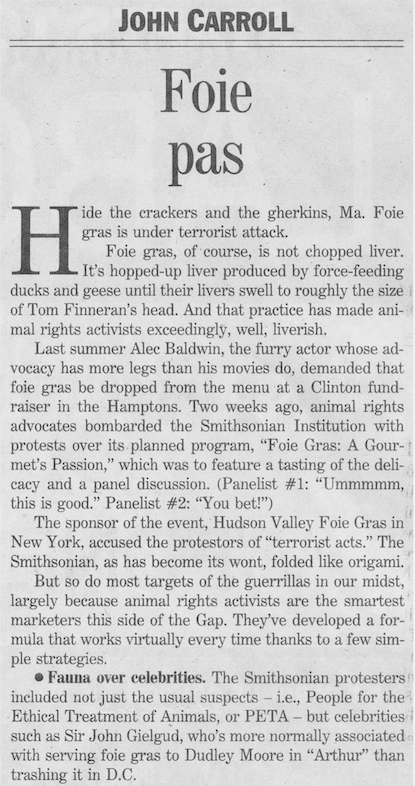
Town of Brookline’s Latest Ban Is Truly a Coup de Foie Gras

The hardworking staff has been a (mostly) proud resident of the People’s Republic of Brookline for a (mostly) good 45 years, so we were understandably drawn to this item in Steph Solis and Mike Deehan’s always informative Axios Boston yesterday.

It’s actually even more draconian than that, as Vivi Smilgius and Sam Mintz report in Brookline.News.

On Wednesday, the town’s legislative body approved a controversial by-law banning the sale of foie gras in restaurants as well as by individuals and stores in Brookline.

Article 20, which was proposed by four Brookline High School students from the BHS Warriors for Animal Rights club, subjects the sale of foie gras in Brookline to a $300 fine enforced by the town’s department of public health and human services, including through random inspections of restaurants and stores.

Supporters of the ban “say the force-feeding process by which foie gras is made is cruel for ducks and geese.” Then again, there are only four establishments in town that even carry the high-priced spread, “one of which — French restaurant La Voile — recently closed, citing the proposed ban as one of the factors in its decision.”

The town’s chopped liver reminded me of the swan song to my decade-long freelance dance with the Boston Globe some 25 years ago (see here and here and here for those of you keeping score at home).

But back to Brookline’s food fight. The town’s coup de foie gras joins multiple other municipal bans it has imposed – “a seasonal ban on gas-powered leaf blowers, and a ban on face surveillance technology. Additionally, Brookline prohibits the sale of tobacco to individuals born after January 1, 2000. There is also a ban on the retail sale of fur,” according to the Googletron.

The mink might not inherit the earth, but they’ve got Brookline wrapped up, yeah?

Posted in Uncategorized | Tagged , , , , , , , , , , , | Leave a comment

C.J. Chivers Tracked Ukraine’s Drone Warfare First – Up Close

The hardworking staff has long admired the journalistic work of New York Times reporter C.J. Chivers  (rhymes with shivers) during his years as a relentlessless war correspondent (Afghanistan, Libya, Syria), a tireless champion of military veterans, and – most recently – a firsthand witness to the drone war in Ukraine.

That last topic is much in the news lately in the wake of this week’s stunning New York Times Ukraine war report with a quintuple byline (Marc Santora, Lara Jakes, Andrew E. Kramer, Marco Hernandez and Liubov Sholudko).

A Thousand Snipers in the Sky: The New War in Ukraine

Drones have changed the war in Ukraine, with soldiers adapting off-the-shelf models and swarming the front lines.

When a mortar round exploded on top of their American-made Bradley infantry fighting vehicle, the Ukrainian soldiers inside were shaken but not terribly worried, having been hardened by artillery shelling over three years of war.

But then the small drones started to swarm.

They targeted the weakest points of the armored Bradley with a deadly precision that mortar fire doesn’t possess. One of the explosive drones struck the hatch right above where the commander was sitting.

“It tore my arm off,” recounted Jr. Sgt. Taras, the 31-year-old commander who, like others, used his first name in accordance with Ukrainian military protocols.

Scrambling for a tourniquet, Sergeant Taras saw that the team’s driver had also been hit, his eye blasted from its socket.

The two soldiers survived. But the attack showed how an ever-evolving constellation of drones — largely off-the-shelf technologies that are being turned into killing machines at breakneck speed — made the third year of war in Ukraine deadlier than the first two years combined, according to Western estimates.

According to one of those estimates, drones now “inflict about 70 percent of all Russian and Ukrainian casualties,” for those of you keeping score at home.

This week’s Times piece also includes eye-popping video, still photography, and graphics (you really should check it out). News outlets ranging from The Bulwark to Slate have name-checked the report, but we’ve yet to see – or hear – anyone cite Chivers’ riveting first-person account of first-person-view drones (FPVs) on the front lines of the Ukraine-Russia war in the Times Magazine two months ago.

The suicide drone beelined toward a strip of forest separating two agricultural fields. A remotely piloted quadcopter with a wingspan narrower than that of a duck, a camera in its nose and an antenna protruding from its tail, it crossed into Russian airspace unchallenged minutes before. An armor-piercing warhead hung from its underside. Now, about 18 miles south of Belgorod, it descended toward cropland with about five minutes of battery power remaining. It was time to hunt.

Several miles away, in the basement of an abandoned home inside Ukraine, the drone’s pilot, who uses the name Prorok, Ukrainian for “Prophet,” clutched the miniaircraft’s controller with both hands and gazed into goggles displaying its live video feed. His team leader, who uses the name Buryi, or “Brown,” sat to his right, monitoring the flight on the bright screens of two tablets while communicating with a distant lieutenant via a laptop. Minutes earlier, a bomb-laden quadcopter flown by another team slammed against a howitzer hidden in the tree line. Prorok and Buryi’s mission was to assess damage, find survivors and kill them.

Spoiler alert: Prorok and Buryi wound up killing four Russian infantrymen and destroying a $3 million Russian T-80 tank . . . all with a $400 repurposed toy.

As the piece notes, “Chivers reported from the front lines and from drone workshops in Ukraine and reviewed footage of thousands of drone attacks.” Props also to Times photographer/videographer , who was with Chivers on the front lines throughout.

And first.

Posted in Uncategorized | Tagged , , , , , , , , , , , , , , , | Leave a comment

Guess Who (Both?) Won the 2024 NYT ‘Year in Pictures’ Bakeoff

Among the many holiday traditions here at the Global Worldwide Headquarters of Campaign Outsider (duck the malls; do not bring me some figgy pudding), one of our favorites is the annual Running of the Photographers – that is, tallying the various photojournalists’ work in the New York Times special section, The Year in Pictures.

In keeping with our Holiday Bakeoff tradition, the hardcounting staff has assessed the excellent work of the Grey Lady’s standout shutterbug Boswells over the past 12 months. We’ll get to the shooter(s) supreme in a moment, but first here’s how managing editor Carolyn Ryan introduced this year’s compilation of images.

When shots were fired at a campaign rally for former President Donald J. Trump on a July evening in Butler, Pa., the veteran New York Times photographer Doug Mills was just a few feet from him. The Secret Service rushed toward Mr. Trump. Mr. Mills’s heart pounded when he realized what was happening.

Then instinct took over. Mr. Mills kept taking pictures, at a fast shutter speed of one eight-thousandth of a second, capturing an image that illustrates the magnitude of that moment: Mr. Trump, his face streaked with blood, his fist raised in defiance.

This year was made up of such extraordinary moments. And Times photographers captured them in extraordinary images. The Year in Pictures brings you the most powerful, evocative and history-making of those images — and allows you to see the biggest stories of 2024 through our photographers’ eyes.

Let’s start with the bakeoff’s Honorable Mentions, all of whom have three entries in this year’s showcase.

Samar Abu Elouf, who contributed seven heart-wrenching shots to the 2023 wrap-up, which we believe to be an all-time TYiP record. This year she traveled to Qatar to photograph wounded Gazans – the collateral damage of the Israel-Hamas war – receiving medical treatment there.

“When I started photographing the story, I could not imagine the amount of sadness I would share with my subjects. I felt very heavy. I cried a lot and felt all the pain they went through. No one in the world deserves to go through what they did. I cry every time I remember all of the horrors they endure . . ..

“Nusaiba Kleib’s leg was amputated after a bombing. She goes around with her prosthetic leg on the back of a little car. It’s as if she has befriended her prosthetic leg.”

Daniel Berehulak, who brought home dramatic images ranging from a dappled sunset over the Paris Olympics . . .

. . . to the glorious sunset of “Bashar al-Assad’s long and brutal reign” in Syria.

Kenny Holston, who ventured north to the Beaufort Sea to capture “the U.S.S. Hampton, a nuclear-powered submarine, surfacing for Operation Ice Camp, a Navy mission aimed at sharpening sailors’ combat skills in the Arctic as Russia expanded military operations there.”

“We were in the middle of the Arctic on a giant floating piece of ice, and out of nowhere a submarine surfaced through the ice. It felt as if I was on a different planet. Trying to work in such harsh conditions was so challenging. I had to use hand warmers to warm up the cameras.”

Todd Heisler, who caught Venezuelan migrant Aldryn Zea in a Brooklyn warehouse/shelter . . .

. . . and an unnamed migrant boy in Manhattan’s Roosevelt Hotel.

“At night I would always see someone looking out the windows, and I thought to myself, I want to know what that experience is like inside. The boy was looking out the window, just kind of fascinated with this landscape of this wall of windows across the way and the Manhattan streets. I was finally able to see that perspective.”

From there, though, the bakeoff gets a bit tricky, since one shooter has four photos in the mix, while another has – sort of – five.

Start with Erin Schaff (co-winner, 2019  TYiP), who delivered striking images both of Kamala Harris on the “Rocky” steps in Philadelphia . . .

. . . and the cargo ship Dali on the Patapsco River.

Then there’s Doug Mills (winner, 2018 TYiP; co-winner, 2021), who has five photos in this year’s bakeoff, one of which – the cover shot for the print edition showing Donald Trump entering a January rally in Manchester, NH – inexplicably does not appear in the web version or on Mills’s Xitter feed.

The other four come from Trump’s July rally in Butler, PA. The main image is the one on the TYiP landing page (see above). Mills shot these three photos moments earlier.

So let’s award equal TYiP 2024 bragging rights to Erin Schaff and Doug Mills, excellent photojournalists both. (This year’s edition also highlights the work of 49 other fine photogs, for those of you keeping score at home.)

Questions, comments, bitter recriminations? Feel free to register them below.

Posted in Uncategorized | Tagged , , , , , , , , , , , , , , , , , , , , , , , , , , | 2 Comments

Xavier University Says ‘We’re Number . . . 500something!’

As I’ve mentioned previously in this space, I did seven years in Ohio from the late ’60s to the mid-’70s: A four-year stretch at Xavier University in Cincinnati, followed by an extended rehab stint after eight long years of Jesuit education.

(Many of the gory details can be found here, but definitely not for the faint of heart.)

Regardless, as a semi-proud Musketeer, back in 2020 I recorded Xavier’s Wall Street Journal College Ranking among the top 500 U.S. universities.

As I noted at the time, “It’s a bitter pill to be bested by Alma College, but boy, did we kick Pacific Lutheran University’s ass, yeah?”

XU dropped to #359 in 2022, then disappeared altogether from the WSJ’s Top 500 in 2023.

Regardless, I eagerly awaited this year’s rankings, which the Journal published the other day.

Sad to say, Xavier University has stayed missing from the Top 500 this year.

Fun fact to know and tell: Xavier University of Louisiana – the only historically Black, Catholic university in the United States – ranks 405 in this year’s WSJ bakeoff.

So dry your Musketears, Xavier of Ohio alums. At least one XU is representing.

Posted in Uncategorized | Tagged , , , , | 7 Comments

Is Babe Ruth’s ‘Called Shot’ Jersey Really Worth $30 Million?

From our kissin’ cousin (Frog Division) at Ask Doctor Ads

Well the Doc opened up the old mailbag today and here’s what poured out.

Dear Dr. Ads,

There I was, minding my own business and leafing through the Weekend Wall Street Journal, when I came across an ad for a New York auction house offering “the Babe Ruth jersey worn during one of the most iconic moments in sports history” – the home run he hit in the fifth inning of Game 3 of the 1932 World Series between the New York Yankees and the Chicago Cubs, which, according to legend, he “called” by pointing to center field right beforehand.

Two questions, Doc: First, did Ruth actually “call” that shot? And if so, are we sure that’s the jersey he wore when he did it?

– Babe Truther

Dear BT,

Good questions both. First, though, here’s the ad.

And here’s the money shot.

Yes, that’s a 30 followed by six zeroes, for those of you keeping score at home . . .

(You can read the rest here.)

Posted in Uncategorized | Tagged , , , , , , , , , , , , | Leave a comment

Dead Blogging ‘Songs for Modern Japan’ at MFABoston

Well the Missus and I trundled over to The Fens the other day to check out Songs for Modern Japan: Popular Music and Graphic Design, 1900–1950 (through September 2) and say, it was swell.

“Songs for Modern Japan: Popular Music and Graphic Design, 1900–1950” explores how sheet music covers provide a window into Japanese society and culture during this period of immense transformation. Visitors discover how leading Japanese graphic designers of the day interpreted modernist international art movements like Art Nouveau and Art Deco, and how demand for military sheet music with propagandist images grew in the 1920s and ’30s, reflecting the country’s imperialist aspirations. Through investigating styles of graphic design, bold typography, genres of music, and the societal environment in Japan, visitors get a glimpse of how design and music celebrating modernity and globalism gave way to endorsing nationalism.

The exhibit includes “about 100 sheet music covers from the collection of Mary and Robert Levenson—alongside paintings, photographs, textiles, music, film clips, and musical instruments from the period.”

Representative samples . . .

As Mark Feeney wrote in his Boston Globe review, “The flatness and solid colors of traditional Japanese prints did so much to influence — and liberate — Western artists in the late 19th century. The work of those artists in turn did so much to influence the Japanese artists responsible for these graphic designs. It’s an artistic case of wheels within wheels — or, if you prefer, frames within frames.”

As well as songs within songs.

Totally worth a trundle.

Posted in Uncategorized | Tagged , , , , , | Leave a comment